Filter by category
School-level student data can inform your future planning, but it can also be useful to take a look at the national picture. In this three-part series, we’ll be delving into the Civics and Citizenship learning area of the Australian Curriculum, and some aspects of the Australian Curriculum: History to explore students’ misconceptions, and share some lesson activities to help your planning for 2022.
In a recent Teacher article, Ben Sacco from the MacKillop Institute discussed three elements that can directly support schools to improve teaching, learning and wellbeing – safety, relational trust, and shared language. In this follow-up, Sacco, and St Pius X Deputy Principal Stacey Atkins and Principal Joe Ewing share how the Catholic primary school has been putting these elements into action.
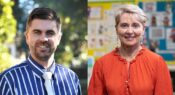
A primary teacher from Queensland and a secondary teacher from Sydney were last night recognised for their contribution to STEM and agricultural science education by being named winners of the Prime Minister’s Prize for Excellence in Science Teaching. Here, we share details of the work they’re doing in their schools.
What are the future directions of teaching writing? Do students write differently when supported by ICT? And, how often do teachers teach writing? In this edition of Researching education: Five further readings, we’re sharing resources on the topic of teaching writing that seek to answer these questions.
‘Climate change is likely the biggest test facing humanity. Equipping young people with solid scientific knowledge and understanding of environmental issues is key to their realistic appreciation of the environmental threats ahead.’ In his final Teacher column for 2021, Andreas Schleicher discusses student awareness and knowledge of environment issues, and how schools can develop their sense of empowerment and agency to make a difference.
As Australia marks World Teachers’ Day, a new survey report released to coincide with the celebrations shines a light on school educators’ passion for and dedication to the profession and lifelong learning. But it also reveals how the job is taking a toll on their wellbeing.
‘Last year offered school leadership teams, amongst other things, the chance to reflect on the hows and whys of education.’ Leon Furze, Director of Learning and Teaching, shares how the leadership team at Monivae College in regional Victoria has made significant changes to the Year 9-12 curriculum.
One of the most popular Teacher articles of all time includes a section on looking at things from a student perspective – for example, checking to see if they have an obstructed view of the board. As a teacher, you also need to be thinking about possible issues with students’ eyesight. Two recent studies from different parts of the world explore the topic of vision screening in schools.
‘Health and Physical Education (HPE) is fundamental for supporting young people to develop the skills and knowledge that will enable them to engage in lifelong health, movement and physical activity behaviours. Ensuring all young people have the opportunity to develop this knowledge is a crucial responsibility for all physical educators.’ Dr Laura Alfrey and Professor Ruth Jeanes share practical strategies for promoting inclusion in HPE.
What is excellence in Indigenous education? This is a topic that’s been widely explored on Teacher this month and in today’s episode, we run you through some of the highlights. This includes a podcast on delivering Indigenous content in the curriculum, and a submission that explores how Indigenous peoples, school leaders and educators conceptualise what excellence in Indigenous education is or could be.
Facebook
YouTube
SoundCloud
Apple Podcasts
Spotify
RSS feed
Linkedin