Filter by category
Each year, the Australian Mathematical Sciences Institute announce winners to a range of ChooseMaths awards. At the 2019 award ceremony, 11 educators were acknowledged and among them was Louise Puslednik. She took home the award for mentoring girls in maths and she joins us in this episode.
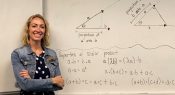
Ashley Stewart, a Mathematics teacher from Newton Moore Senior High School, Western Australia, was named in the top 50 shortlist for the 2020 Global Teacher Prize. She joins us today to discuss her approach to STEM education and how she’s been boosting girls’ uptake and engagement in these subjects.
One teacher from Australia has been named alongside educators from 37 other countries in the top 50 shortlist for the Varkey Foundation Global Teacher Prize 2020. Here, we look at the work she’s doing in her school.
In a two-part series, Teacher is taking a closer look at some of the proposed reform directions in the New South Wales Curriculum Review Interim Report. This final instalment explores curriculum flexibility and integrated learning.
In this special podcast episode, we’re joined by both recipients of this year’s Prime Minister’s Prizes for Excellence in Science teaching. Both educators are remarkably dedicated to harnessing curiosity in Science with their students, and in this episode, expand on how they do this so successfully.
Research from the University of Newcastle has shed light on how young people come up with answers to the question ‘what do you want to be when you grow up?’ and the implications for educators.
Can simple prompts help encourage more trainee teachers to apply for placements in rural and remote schools? In today’s Q&A we speak to Dr Karen Tindall, a Senior Adviser at the Behavioural Insights Team Australia about a trial in New South Wales.
At a primary school in Melbourne, students learn the skills of engineering by building their own solar powered vehicles, a task which culminates in a race to see which vehicle runs the fastest. We speak to the Assistant Principal about how it’s enhancing student learning.
What a month we’ve had here at Teacher magazine! From Research Conference, to Science Week, to our very first live event with Dr Lyn Sharratt – there’s so much we’d like to look back on and share with you in today’s podcast.
The Australian Department of Industry, Innovation and Science commissioned a study to examine the attitudes of Australian students towards STEM (Science, Technology, Engineering, Mathematics). In this infographic, we take a look at some of the findings.
Facebook
YouTube
SoundCloud
Apple Podcasts
Spotify
RSS feed
Linkedin