Filter by category
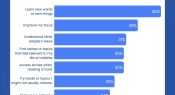
Research involving over 110,000 children and young people in the UK has revealed that many listened to audiobooks in 2026, saying listening to audiobooks feels like reading and that they listen to audiobooks to give their eyes a break from screens. Here, we share the reasons why 8-18 year olds say they turn to this format to support their learning.
‘Community collaboration does not need to begin with a new program or excursion. Often, the simplest starting point is creating a small, clear role for an organisation within something your school already does.’ Churchill Fellowship recipient Dr Luke Steller, Questacon Regional Leader for the NT, shares 6 practical ways educators can build stronger school-community partnerships.
Day one of the Australian Council for Educational Leaders (ACEL) National Conference 2026 has kicked off in Perth with keynotes and presentations on the theme of Bold Leadership: New Frontiers in Education. Presented in partnership with the Australian Council for Educational Research (ACER), the conference has drawn delegates from around the world to explore complex leadership, the future of learning and the evolving role of educators.
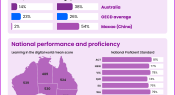
The Programme for International Student Assessment (PISA) shows how well 15-year-olds can apply their knowledge and skills in science, reading and mathematics to real-world situations. In addition to the 3 core domains, an innovative domain important in modern societies is included in each test cycle. In 2025 the innovative domain was ‘Learning in the digital world’. This infographic shares Australia’s performance in an international context.
‘Tour a school and you’ll likely see many classrooms displaying finished student work … perfection is visible; process is private. … The Thinking Museum is a classroom routine that makes intellectual growth visible, celebrated, and unforgettable.’ Find out more in our latest reader submission from K-12 teacher Varun S Nair.
In case you missed it, the PISA 2025 results were recently released. As is always the case, there is plenty to digest. This month at Teacher, we’ve shared insights from many experts to begin to unpack the results. In this episode of Teacher Staffroom, we catch you up.
Following the release of the PISA 2025 results last week, Dominique Beech is joined by Dr Jonas Bertling, Research Director of ACER Implementation and Reporting and co-author of the report sharing Australia’s PISA 2025 results, to unpack the 2025 findings and the implications for educators.
‘PILNA helps countries see not only whether students are meeting expected levels, but also the conditions that support or constrain learning.’ The latest results from the Pacific’s largest regional education assessment point to encouraging signs of recovery in student learning, while also identifying key areas where further improvement is needed.
Teacher magazine is delighted to welcome Lisa Rodgers – CEO of ACER – as a columnist. In this first article, she offers a different story about PISA that is built around 5 ideas – position, direction, distribution, resolution and ambition.
The latest OECD Programme for International Student Assessment (PISA) results have just been released. In his latest Teacher column, OECD Director of Education and Skills Andreas Schleicher shares some of the early data and insights, including the changing landscape of reading performance and translating scientific talent into scientific ambition.
Facebook
YouTube
SoundCloud
Apple Podcasts
Spotify
RSS feed
Linkedin