Filter by category
How often are teachers using AI in their work and the classroom, what type of tasks do they use it for, and what are the common tools? These are some of questions being explored in a 5-year study investigating the influence of AI in teaching, learning, and assessment.
The 2026 winners for the Australian STEM Video Game Challenge have just been announced. The free national competition, run by the Australian Council for Educational Research (ACER), has invited primary and secondary students to build their skills in STEM by designing and developing their own video game since it launched in 2014.
In his latest Teacher column, Professor Martin Westwell, Chief Executive of the South Australian Department for Education, argues explicit instruction, classroom technology and AI raise the same essential question: who is doing the thinking? ‘The aim is not to make learning harder. It is to make sure the hard thinking is happening in the right place.’
Recorded live at the National Education Summit in Melbourne, Dominique Beech sits down with Professor Miriam Tanti from La Trobe University to find out about the research she and her colleagues have been conducting into the science of learning and Generative AI which has culminated in a free, practical guide for secondary school teachers.
‘The most formidable change we have seen so far is consistency in AI use. Along with staff, students from years 5 to 12 are now working off the same scale and AI use is thought about before a task is set, not discussed after.’ In this article, Jill Fitzsimons, Director of Teaching and Learning at Loreto Toorak shares how staff and students have been supported to use AI, and how the impact of AI is shaping assessment.
Day one of the Australian Council for Educational Leaders (ACEL) National Conference 2026 has kicked off in Perth with keynotes and presentations on the theme of Bold Leadership: New Frontiers in Education. Presented in partnership with the Australian Council for Educational Research (ACER), the conference has drawn delegates from around the world to explore complex leadership, the future of learning and the evolving role of educators.
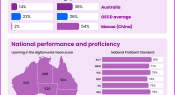
The Programme for International Student Assessment (PISA) shows how well 15-year-olds can apply their knowledge and skills in science, reading and mathematics to real-world situations. In addition to the 3 core domains, an innovative domain important in modern societies is included in each test cycle. In 2025 the innovative domain was ‘Learning in the digital world’. This infographic shares Australia’s performance in an international context.
Following the release of the PISA 2025 results last week, Dominique Beech is joined by Dr Jonas Bertling, Research Director of ACER Implementation and Reporting and co-author of the report sharing Australia’s PISA 2025 results, to unpack the 2025 findings and the implications for educators.
Teacher magazine is delighted to welcome Lisa Rodgers – CEO of ACER – as a columnist. In this first article, she offers a different story about PISA that is built around 5 ideas – position, direction, distribution, resolution and ambition.
The latest OECD Programme for International Student Assessment (PISA) results have just been released. In his latest Teacher column, OECD Director of Education and Skills Andreas Schleicher shares some of the early data and insights, including the changing landscape of reading performance and translating scientific talent into scientific ambition.
Facebook
YouTube
SoundCloud
Apple Podcasts
Spotify
RSS feed
Linkedin